Monday, March 7, 2016

The Evolution of Customer Engagement (And How It’s Changing Everything)

How do you measure customer engagement? If you’re like most marketers, it’s all about the revenue. And while revenue is important, much of what we think about customer engagement is changing considerably.


For example, according to a recent report by eMarketer, most executives look at metrics like clicks, conversions, shares and traffic as prime indicators – but these metrics can’t really measure engagement per se and nor can they measure a customer’s satisfaction with the service they received.


In fact, just look at how marketers view the shifting customer service landscape:


CMOCouncil-Changing-Ability-to-Reach-Engage-Customers-Jan2016


Nearly half of those surveyed felt that they needed to better align with sales and support to deliver a complete customer experience. But how exactly do you do this? Looking at three of the more considerable metrics on the chart above reveals some insights when it comes to personalization, filtering and what information is collected about customers (and what information they choose to share).


The Signal-to-Noise Ratio


It’s evident from the graphic that customers are now available and open to receiving information than ever before. But for the uninitiated company, this doesn’t mean simply “throw out all the advertising you can at them and hope some of it sticks.” People are tired of being marketed to like brainless zombies, and instead want their business to be valued. They want to share their experiences with friends on social media and rave about the latest deals or what fantastic service they got.


BUT – and this is a big one – customers don’t want to be babysat. They don’t want to be reminded for the umpteenth time to leave a review about the cat litter they just bought. Nor do they want to be doggedly followed from site to site showing ads for that lingerie they were looking at. They want less noise and more tailored offers, personalized to their tastes.


Importance Versus Satisfaction


In customer service, a lot of effort goes into explaining (and looking for ways to create) “memorable moments”. These are moments where the customer shopping experience was so good/timely/affordable that they can’t help but remember it.


Now, it’s important to note that a customer isn’t going to have a memorable experience every single time they shop. But looking at these experience (and their relative levels of importance) is a good way to set and manage customer experiences.


custex

Image Source


Imagine for a moment if expectations were low, but experience was high. A customer might remember that moment, right? And conversely, if expectations were high and experience low – a customer will definitely remember it – and likely tell others.


Being able to accurately pinpoint where (on the map) the customer interacts with the company and how to make these points as even as possible is the “sweet spot” every company – whether you’re selling lingerie, or cat litter – needs to aim for.


Physical Versus Emotional Variables


There are a lot of core physical variables that customers look for no matter what they’re buying. Things like:


  • Functionality (does it work as intended)

  • Time (is it easy to set up/use)

  • Attractiveness / Cleanliness

  • Environment (the ambience of the store / website)


These are all physical points that you can control to some extent. Interjecting emotional value into physical points broadens the overall customer experience into so much more. Love it or hate it, you know when you’re entering a Hollister store. The dark lights, the music, and even the smell.


That’s not to say that all customer experiences should be 100% sensory only. But making them feel things in connection to shopping online (the excitement of getting a branded package from Amazon.com, for instance), greatly heightens their satisfaction and in effect, doing business with you.


Tying Customer Experiences to Measurable Goals


Here’s the real question: How do you measure something as intangible as customer experience? Sure, the aforementioned metrics are a good place to start, as is overall customer satisfaction levels –but they don’t paint a complete picture.


It’s vital when considering customer experiences as a whole that you look at the areas where improvements can always be made – such as:


  • How easy it is to find information

  • How to get help when they need it

  • How their personal data is being collected and used

  • Appealing, interesting content


attribute

Image Source


This marketing matrix, from the Customer Experience (Spain) shows how you can tie those improvements to overall goals to make real progress toward your customer engagement improvement initiatives. This will give you concrete milestones to work from as you keep improving your process. It won’t happen overnight, but gradually, you’ll be able to see impactful improvements to metrics like time-on-site, lower bounce rates, social shares and other measurable points.


And if you’re not getting the kind of results you’d hoped for, don’t be afraid to make changes and shift with the changing customer experience tides. People are rightfully expecting a lot more out of the companies they’re most loyal to, but companies aren’t afraid to take some risks and step up to the place to align themselves with their customers’ needs too.


The bottom line is always going to be to look at what your data is telling you. Draw meaningful conclusions, but don’t doggedly cling to it. We’re all human, and sometimes unpredictable and wavering in what we really want from a brand.


But it doesn’t have to be overwhelming. In an August 2015 survey from Ovum and Opinium Research LLP, nearly 81% of the customers surveyed reported that the issue [which would give them the greatest positive experience with a brand] would be to simply have their questions answered. That’s not asking for a lot, is it? They’ve set the bar incredibly low – presenting the perfect opportunity for smart companies to not just meet their expectations but exceed them.


What Do You Think About the Shifting Customer Service Landscape?


Now it’s your turn. Do you feel like your company could improve on customer engagement? Or have you already made great strides and are looking to do more? Tell us about your experiences in the comments below!


About the Author: Sherice Jacob helps business owners improve website design and increase conversion rates through compelling copywriting, user-friendly design and smart analytics analysis. Learn more at iElectrify.com and download your free web copy tune-up and conversion checklist. Follow @sherice on Twitter, LinkedIn or Google+ for more articles like this!


Saturday, February 20, 2016

5 Noteworthy Ways to Increase Engagement for Your YouTube Videos (Infographic)

You may have mastered every trick in the book to drive millions of viewers to your YouTube channel. If so, it's great that you have people watching your video.


However, that shouldn't be your only concern. Don't make the mistake of thinking that virality is your goal. Your goal is to engage your audience and keep them coming back for more.


When creating your videos, always remember that you are addressing people, not robots. You must make an emotional connection with your viewers.


According to a study by the National Center for Biotechnology Information, the average time a user spends on a website is only 20 seconds.


The study also reported that the average attention span of a human being, in 2015, was 8.25 seconds, which is even less than that of a goldfish!


This means that people lose interest fast if what they see is boring. Hence, you need to hook your viewers within the first 10 seconds of your video.


So, where does engagement begin and where does it end?


The longer a video drags on the lower its retention rate. Short videos, under 1 minute, enjoy 80% viewer retention. Videos that are 2-3 minutes long receive 60% retention. But, videos that are 5-10 minutes long have only about 50% retention halfway through.


People watch videos for a variety of reasons. Most people (70%) are looking for educational content, such as DIY tips and tricks and tutorials. Some people (67%) visit YouTube for reviews of products they are interested in buying. And, some people (53%) turn to videos for inspiration or entertainment.


A further breakdown of shoppers looking for product reviews shows that:


  • 52% of shoppers agree that watching product videos makes them more confident about making a purchase

  • 40% of shoppers agree that they would visit a store online or in-person after watching a video

  • 46% of shoppers said they would be more likely to seek additional information about a product after watching an online video about it


The bottom line is: Engagement is important for good conversion rates. So, let's examine 5 ways to increase YouTube channel engagement. These methods will help you to not only attract a wider and more diverse viewership, but also retain customers and generate leads.


YouTube-engagement-infographic


About the Author: Subrat Kar is the CEO and Co-founder of Vidooly, a YouTube analytics tool for content creators, multi-channel networks, and brands. Before Vidooly, he worked with E-Commerce companies like Jabong and IndiaMart as a product manager. Recognized as one of the most promising young entrepreneurs in India, he is an active participant in entrepreneurial initiatives and forums across India. Connect with him @subratkar.


Wednesday, February 17, 2016

Cosmo's Editor Suggests Brands Will Be Able To Sell Products Through Snapchat Discover

Joanna Coles says Hearst's "Sweet" channel on Snapchat Discover will eventually evolve into an e-commerce platform.


Please visit Marketing Land for the full article.


Tuesday, February 9, 2016

How To Find Your Competitors' Bidding Schedule

When digging into Auction Insights in the AdWords interface, you are able to utilize segments, with time and device as the options of segmentation.


Read more at PPCHero.com

How to Create Blockbuster YouTube Channel Success in Any Niche--No Matter How 'Boring'

How can you develop a YouTube channel that stands out? It so happens that successful business channels have qualities in common that anyone can replicate. Do so, and you'll be rocking the No. 2 search engine in the world. Read the full article at MarketingProfs

Monday, February 8, 2016

How To Get Google To Index My Website

Getting your website indexed seems like a simple thing. However, you might be confused as to how it happens. More importantly, you might not realize the different steps you should be taking to improve your indexation. Getting your website indexed is the only way that Internet marketing can be successful. It's the entire starting point. [...]


The post How To Get Google To Index My Website appeared first on The Daily Egg.

Tuesday, February 2, 2016

Why Your Conversions Suck (And How to Fix It)

Average site conversion rates hover around 1-2%.


That means at any given time, you have another 98-99% of people just hanging out.


So... WTF are they doing?


They're looking, searching, procrastinating, hunting, browsing, considering, analyzing, evaluating, thinking, questioning, investigating, and comparing.


Basically they're doing a bunch of stuff — besides purchasing — that might, one day, hopefully, lead to a purchase.


Your goal, site owner, is to help move them along.


Here's how.


Are You Treating Different People, Differently?


When a site is struggling with low conversions, one of the first red flags is segmentation.


Or rather, a lack thereof.


(I've always wanted to use that word in a blog post.)


Specifically, are you treating all website visitors more-or-less the same?


The classic example is when AdWords traffic is going to your homepage. Or when your entire email database is seeing the same 'special offer' email.


If the best forms of marketing promotion are the right message, to the right person, at the right time, your website is no different.


The problem is that every single visit or session is unique (to a point). They're different people, with different levels of awareness, looking or searching for different things.


And when generic tactical decisions are applied to all, results suffer. Or are nonexistent.


But fear not. There is a way around this.


The key is to determine:


  • WHO is coming to your site (specifically),
  • WHY they're coming (motivation),
  • WHAT is their intent (what are they going to do when they get there),
  • And WHERE are they going to go (the next logical step)

Here's how to figure it out, and where you can improve.


Start Breaking Down Visitor Intent by Buying Cycle Stage


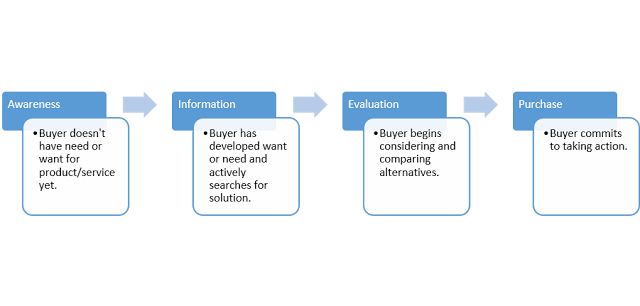
Most savvy readers are familiar with the buying cycle, or stages people go through before making a purchasing decision.


Typically your website visitors fall somewhere along the following:


  • Awareness: Although they're beginning to recognize a related topic of interest, many times they still aren't even aware they have a need for your product or service.
  • Consideration (or Information and Evaluation): Visitor begins to recognize a potential need for a solution, and is starting to evaluate potential solutions.
  • Decision (or Purchase): Here (and only here), is the visitor looking to actively make a decision to work with you in some capacity to solve their problem.

buying-cycle


The trick then, is to begin segmenting visitors by determining where groups of people might fit along this path.


Then, we can use this initial knowledge to help hypothesize the rest of the answers.


Awareness


Site visitors in the 'awareness' stage probably make up the bulk of your site traffic (assuming you're doing a lot of promotion and have at least a few thousand monthly visitors), making up anywhere from 40-70%


Because these people aren't need-aware quite yet (they might not even be brand-aware at this point), pimping sales offers is useless.


Instead, they're probably looking for some general information or education about some topic. That's why many of them tend to come into your site through blog posts (again, assuming you're actively promoting your site) and other unbranded pages.


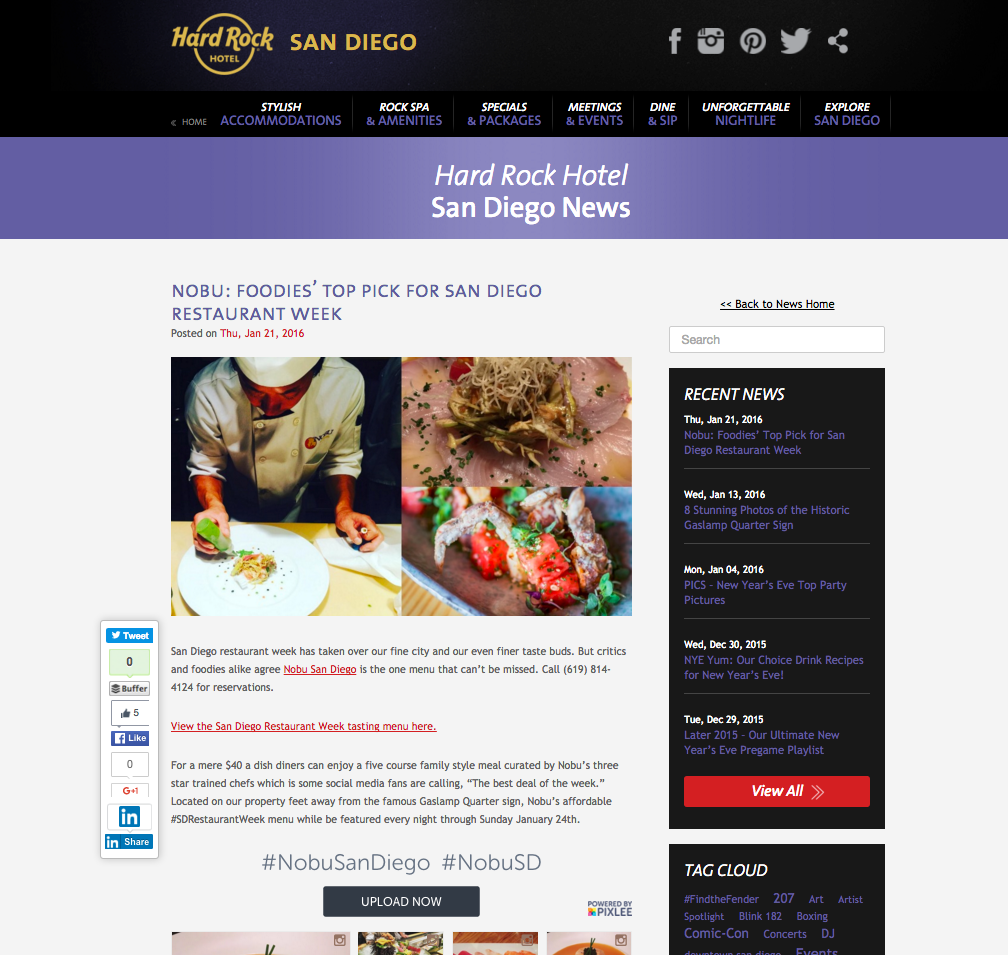
For example, a visitor queries 'san diego restaurant week' and lands on a blog post on your site.


hard-rock-san-diego-news-screenshot


These people are so far removed from being a good sales opportunity, so your goal is to start setting up micro conversions, of different levels, to get something — anything! — from them so you're able to continue following up.


First and foremost, keep them on-site! The Hard Rock's sidebar features a Search bar, followed by Recent News to keep people clicking around (other topically-related content or events in this case).


hard-rock-recent-news


They also feature a Tag Cloud with some of the biggest events also listed, including Comic-Con or the upcoming Valentine's Day.


hard-rock-tag-cloud


The blog post itself features other guest's experience with instagram, and provides a way for the casual visitor to see more about the 'scene' or even join the fun themselves.


nobu-san-diego


Last but not least, the blog post also features a Menu link to let people (a) browse to learn more and (b) entice them to recognize a need ("Hey – let's go get sushi!").


san-diego-restaurant-week


All of these little details have one goal in mind – keep people around long enough so they recognize that need and move into the next stage (of 'Consideration').


And if all else fails, you can use remarketing campaigns, like a restaurant week discount offer, to rope in visitors who're leaving without providing at least an email.


One awesome tip with shared external content is to create a server redirect that will fire a 'website custom audience pixel' within Facebook ads before ultimately redirecting the visitor. Then you'll be able to retarget these people on specific topics after they leave your site.


Check out this detailed guide on Facebook Ads cost if you're interested in figuring out how to get a campaign like this up-and-running.


Consideration


Once people have recognized some need in their life, a tiny little opening has been created that your brand might be able to fulfill.


Generally speaking, somewhere between 10-30% of your site visitors might fall here at any given time (don't check my math).


These visitors are beginning to consider their options and alternatives. Not only are they a little more knowledgeable about what you do at this point, but they're also beginning to recognize the jargon or local slang used to differentiate between things.


Like, for example, neighborhoods within a city when they Google 'Gaslamp hotels'.


hard-rock-hotel-san-diego-homepage


Not only are they looking for a hotel in Downtown San Diego, but they've also narrowed it down to a specific neighborhood, (hopefully) eliminating their other alternatives or options within a few square miles.


These people are ripe for a landing page, covering one specific topic (the one they were looking for!) in detail.


gaslamp-quarter-screenshot


When you've got someone on the hook, you can also use similar landing pages to keep them browsing around for a bit before bouncing. Here, Hard Rock uses the secondary navigation on the left of the content.


explore-san-diego-UI


The opening paragraph of the landing page perfectly positions the primary point on the page (wow, that was annoying).


Prominent (there it goes again) links pointing to the Hard Rock's rooms and nightlife options help to take someone who's already evaluating their options deeper into the site while also providing them a chance to show off what differentiates them best (like, a good time!).


hard-rock-san-diego-district


Decision


The main reason your website conversions suck is because only around 10% or less of current website visitors might be ready to make a decision.


The rest, as discussed, are chillin.


But the good news, is that these people know you. Chances are, they're looking for you by name with a branded search, like 'Hard Rock San Diego'.


hard-rock-san-diego-homepage


These peeps have looked around. They've considered a few alternatives. And in this example specifically, they've also utilized influential 3rd party sites like Yelp and TripAdvisor.


What better way to tempt someone so close to purchase with a special offer or package.


hard-rock-choose-your-experience


Hard Rock does a nice job highlighting the seasonal (and most profitable) ones first, while following it up with the more heavily discounted stuff at the bottom (so it's there, but... don't the other ones look way more fun!).


The drop downs help you quickly browse through the highlights of each package (even though it might be a bit wordy).


valentines-day-hard-rock-san-diego


So you're telling me that I don't even have to think about or plan this Hallmark holiday and I can just check-in with my wife while you take care of the rest? Here's my credit card number.


Also, if that red button with decent copywriting (complete with typo – whoops) doesn't entice you, there's a global footer CTA on the bottom of the page that funnels you into their booking system where you're trapped for all eternity. Just kidding. I hope... :(


hard-rock-valentines-day-copy


3 Takeaways to Increase Conversions


Phew. That was a lot of writing to make a very small point.


And that is: A/B testing a single element on a single page won't improve your site's conversion rate.


The way you make big conversion improvements it by making a lot of tiny ones, first.


Here's where to get started.


Tip #1. Make the Basics, Basic


Start by figuring out where you're at within each stage.


You know: user flows, page level user behavior, click tracking, surveys. All the 'blocking and tackling' of basic site analytics.


Then implement 'best practices'. A quick Google will provide amazing resources for all the basics, like the essential "https://blog.kissmetrics.com/landing-page-design-infographic/">landing page elements.


Also, make sure your S#!^ is fast. Ain't nobody got time to wait longer than three seconds for pages to load. Managed WordPress hosting company Kinsta has one of the best guides on the topic, in a Beginner's Guide to Website Speed Optimization.


Oh, also make sure you have enough traffic in the first place. Generally, that means A LOT. Most site owners would be better served by simply pouring more resources into the top of the funnel first, before over-prioritizing conversion optimization.


If you haven't got the basics covered, there's no point in moving on to the advanced stuff.


Tip #2. Form Hypotheses


After analyzing user behavior for a few weeks, the next step is to make some educated guesses about what they want, what's not working, and how you might be able to fix it.


Go on, stick your neck out. Come up with a few likely scenarios.


You may be wrong. But you also may be right. (Where have I heard that before?)


HOW can you improve a visitor's path and get them to logical 'next step'?


Should you remove pages, and make it easier? OR should you add options to increase Pages per Session (so visitors have a chance to become interested before moving onto the next step)?.


Convesrion XL has a thorough 'customer journey maps' guide if you're looking for concrete ideas.


Once you have 'path's and micro-conversions set-up, you can begin to drill deeper to see where stumbling blocks are, or gaps that can be improved.


And because you're focusing on the tiny interactions, it should be easier to iterate or make adjustments


Which brings us to…


Tip #3. Eliminate Distractions


It's impossible to improve overall website conversions from 1 to 2% in one fell swoop.


However it IS possible to begin fixing site conversions from Awareness to Consideration, and then Consideration to Decision. Optimize the little steps within the customer lifecycle to move the big needle.


Breaking it down into manageable chunks not only makes it easier to execute, but it also makes it easier to focus on making the right choices in specific scenarios to set you up for future success.


Execution is everything.


And in a world where options are limitless, constraints help prioritize that the important stuff — the biggest gaps or stumbling blocks along the entire customer journey — are addressed first.


About the Author: Brad Smith is a founding partner at Codeless Interactive, a digital agency specializing in creating personalized customer experiences. Brad's blog also features more marketing thoughts, opinions and the occasional insight.